Field notes Access
Tube-and-clamp vs system scaffolding for industrial work
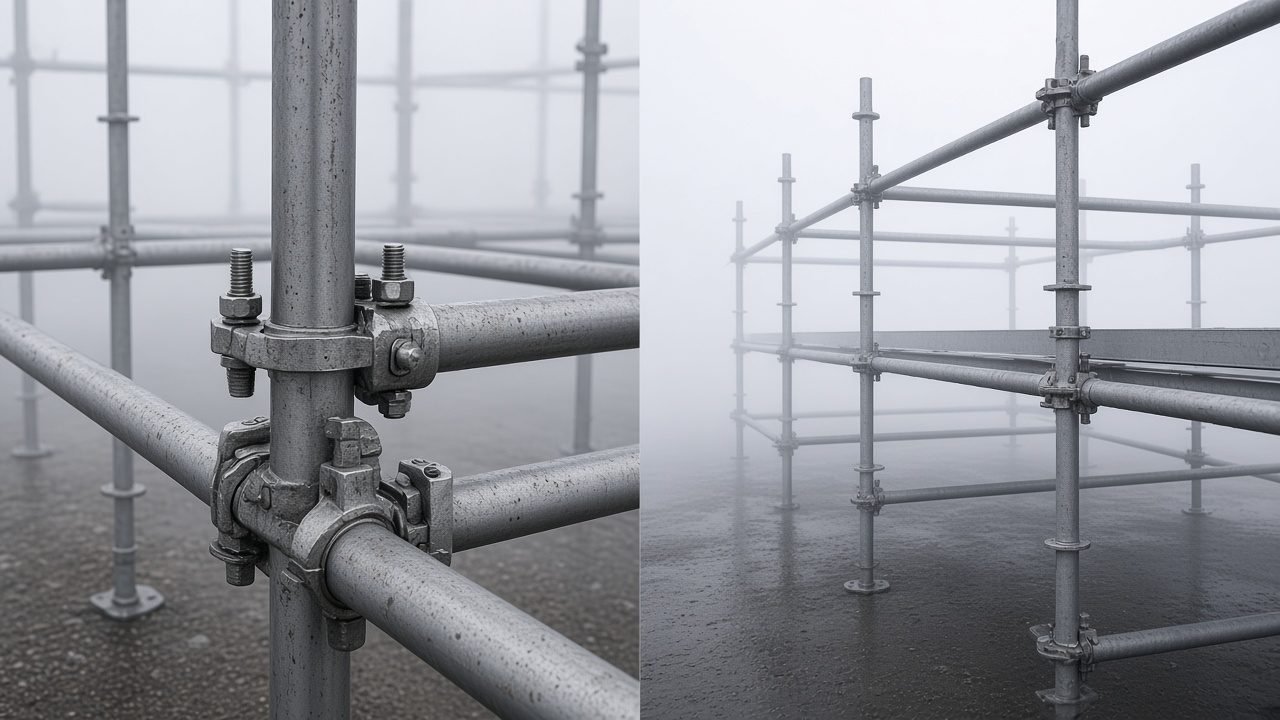
Industrial scaffolds in Alberta usually fall into two families: tube-and-clamp (tubes and fittings erected to the geometry) and system scaffold (fixed nodes, repeating geometry). Neither is “better” in the abstract. The right choice follows shape, load, time to erect, and the competent crew that will build it.
This note compares methods. It does not name a brand as PrimeTime inventory and does not invent erection speeds or load ratings.
Answer first
Use system scaffold where the bay repeats and manufacturer node spacing fits the work. Use tube-and-clamp where the structure twists, steps, or ties into odd steel. Mixed sites are common. Alberta still requires design for load (s.325), metal scaffold to manufacturer or P.Eng. specs (s.331), and tags where s.326 applies.
Tube-and-clamp
Tubes and fittings let the erector follow pipes, vessels, and irregular frames. Strengths: flexibility around existing plant steel. Costs: more fitting decisions, more inspection points on clamps, and a higher dependence on erector skill. Buyers should ask how couplers are checked and how the duty rating is proven on irregular shapes.
System scaffold
System scaffold uses standards with fixed connection points (cups, rings, or similar). Strengths: speed and consistency where geometry repeats—facades, rectangular frames, long runs of identical bays. Limits: fighting the node grid on congested racks can waste time or force awkward ledgers. Buyers should require the manufacturer manual on site and erection by people trained on that system.
Decision table
| Question | Favours tube-and-clamp | Favours system |
|---|---|---|
| Geometry | Irregular, stepped, dense pipe | Repeating bays |
| Change frequency | Many mid-job reshapes | Stable footprint |
| Crew skill | High clamp competence | System-trained crew |
| Documentation | Method for non-standard shapes | Manufacturer manual + node plan |
| Load | Either—must meet s.325; P.Eng. when triggered | Either—same Code |
Alberta compliance is family-blind
Section 331 does not prefer a brand. It requires metal scaffolding to manufacturer specifications or specifications certified by a professional engineer. Section 325 still sets the four-times design rule and the 367 kg/m² engineer threshold. Tags follow s.326 for named types. See Alberta scaffold rules and scaffold tags.
What to put in the RFQ
- Preferred family, or “vendor proposes with rationale”
- Drawings or model slices of the work face
- Live load and material staging
- Whether mixed families are allowed
- Competent person and training evidence for the chosen system
- Tag and inspection protocol
Service pages for standing access: Access scaffolding. For equipment-only scope, see Rentals vs erection service.
Hybrid interfaces
When system meets tube-and-clamp, define the handover bay. State which crew owns the clamps on the interface ledger and which inspection checklist applies. Many incidents sit on orphaned interfaces nobody claimed.
Load class language
Speak in duty ratings and kg/m² that match your engineer or manufacturer table. Do not paste ring-lock marketing capacities from another project. If the bay may exceed 367 kg/m², budget P.Eng. design under s.325(3).
Training evidence to request
- System certificate or manufacturer training record for the exact system
- Clamp identification and torque or seating checks for tube-and-clamp
- Competent person for tagging
Inventory and logistics
System gear is less forgiving when key ledgers are short on truck. Tube-and-clamp needs enough fittings of the right type. Ask for a material list tied to the drawing, not a vague “truck of scaffold.”
Inspection focus by family
Tube-and-clamp: coupler seating, orientation of right-angle vs swivel fittings, tube end conditions, and ledger continuity.
System: locking of nodes, correct ledger lengths for the bay, base jacks, and manufacturer brace patterns.
Both still need platform width, guardrails, and access rules from Part 23 and the applicable CSA practice your specification names.
Spare gear strategy
List critical spares on the truck ticket: base jacks, toeboards, and the coupler or node parts that stop a bay. Mid-outage shortages create unsafe substitutions.
When to force a redesign instead of forcing a family
If the chosen family needs extreme improvisation to fit, stop and redesign. A forced fit is how loads and ties get compromised. Bring the engineer or manufacturer rep in when the drawing and the steel disagree.
Spec language you can paste and edit
“Vendor shall propose tube-and-clamp, system scaffold, or a documented hybrid. Proposal must cite Alberta OHS Code Part 23 ss.325 and 331, identify manufacturer manuals for system gear, and state competent person roles for erection and tagging under s.326.”
Field trial on a pilot bay
For contested choices, erect a pilot bay of each family on a non-critical face and compare erect time, inspection clarity, and modification ease. Record the result for the standards committee instead of arguing from preference alone.
Buyer myths to drop
- “System is always cheaper.” Not on irregular racks.
- “Tube-and-clamp is old and non-compliant.” Compliance is Part 23 and specs, not age of method.
- “Hybrids are forbidden.” Hybrids need ownership, not prohibition by default.
Manufacturer manuals on the face
For system scaffold, the manual is a controlled document. Version it in the work package. For tube-and-clamp, write coupler inspection criteria into the method. Either family fails when the paperwork stays in a truck while the bay is built from memory. Code backbone: Part 23.
Related reading
- Alberta scaffold rules: Part 23 on one page, including s.331 for metal scaffold
- When a scaffold needs an engineer
- Scaffold ladders, planks, and platforms in Alberta
- Scaffold tags in Alberta
- Scaffold rentals vs full erection service
- RFQ checklist for industrial scaffolding
Both families are available through PrimeTime access scaffolding and equipment rentals. Ask for a quote with the geometry and load in hand.
FAQ
Which system is required by Alberta law?
Neither family is mandated by name. Part 23 and manufacturer or P.Eng. specifications govern. Choose by geometry, load, and competent erection.
Can both families appear on one plant?
Yes. Many sites mix system on repeating bays and tube-and-clamp on irregular tie-ins. The method should say who owns each interface.
Do both need tags?
Tagging follows s.326 for the scaffold types it names, regardless of family branding.