Field notes Safety
Scaffold tags in Alberta: green, yellow, red, and the 21-day rule
A scaffold tag is the one document on an Alberta site that every worker reads. Section 326 of the Occupational Health and Safety Code fixes the three colours, the five things a tag must say, the 21-day inspection and expiry clock, and who may climb when the tag is red, expired, or missing. This guide goes past the summary: how to read a tag in ten seconds, a worked expiry example, who carries each duty, and how an owner or prime contractor can audit tags on a walkdown.
It quotes the public King’s Printer text of Part 23. It is not legal advice.
Answer first
Every entry point to a scaffold carries a green, yellow, or red tag. For the seven scaffold types named in s.326(2)–(3), a competent worker inspects and tags before first use and at least every 21 calendar days while the scaffold is worked from or loaded. Each tag expires 21 calendar days after the inspection on it. A red, expired, or missing tag closes the scaffold to everyone except the competent workers building, inspecting, or taking it down.
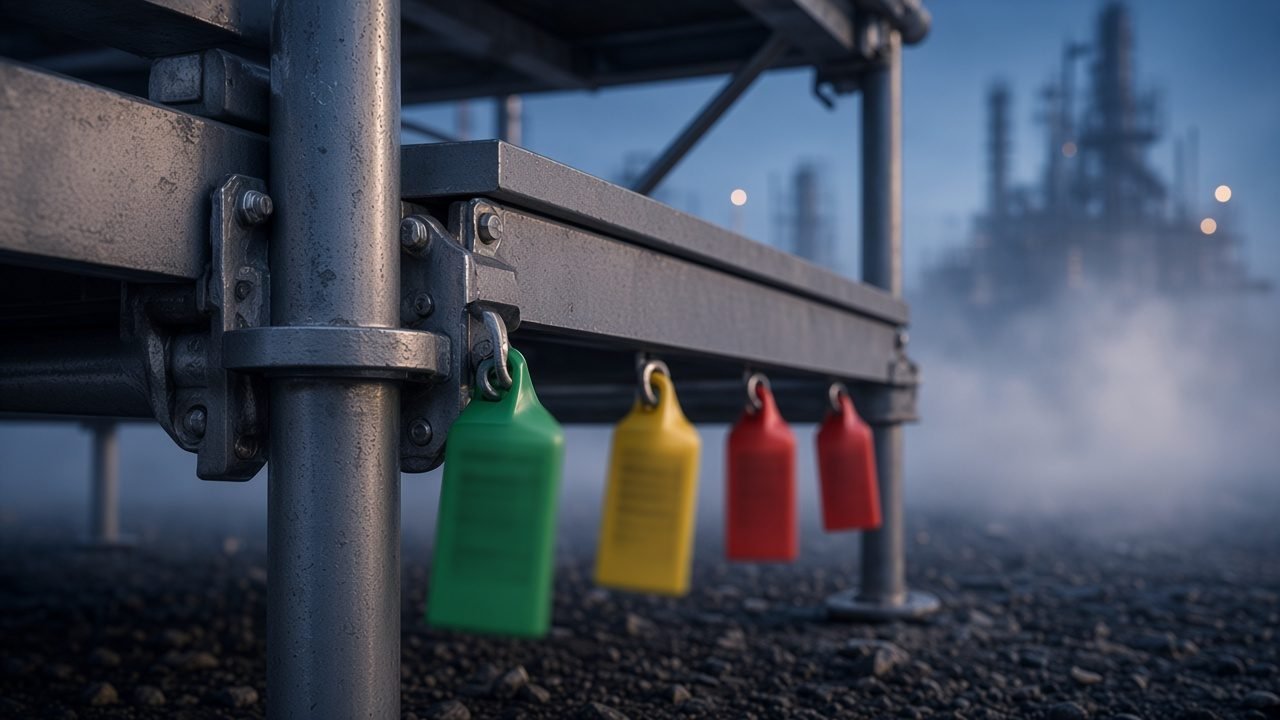
What each colour asks of you
| Tag | Wording the Code gives (or similar) | What you do at the entry |
|---|---|---|
| Green | “Safe for Use” | Check the expiry date and the duty rating, then work within that rating |
| Yellow | “Caution: Potential or Unusual Hazard” | Read the written precaution and follow it; if none is written, treat the tag as incomplete and ask supervision |
| Red | “Unsafe for Use” | Do not climb. Report it if you expected the scaffold to be ready |
Similar wording is allowed, so tag stock from different suppliers can read slightly differently. The colour is what has to be obvious at a glance.
How to read a tag in ten seconds
Section 326(5) lists five fields. Read them in this order:
- Expiry date. If it has passed, stop. The colour no longer counts (s.326(6)(b)).
- Duty rating. Compare it with the load your task puts on the deck: people, tools, and stored material. Section 325(5) also says workers are told the maximum load.
- Precautions. On a yellow tag this is the whole point of the tag. Typical examples are a bay under modification, restricted access to one level, or a limit on stored material.
- Date of last inspection.
- Name of the competent worker who inspected it. Legible, so a question has someone to go to.
A tag with a blank duty rating, a blank expiry, or “TBD” written in is not a usable tag.
A worked 21-day example
A pipe rack scaffold (single-pole) is inspected and green-tagged on Monday, 2 November 2026.
- Under s.326(4), that tag expires on Monday, 23 November 2026, which is 21 calendar days after the inspection.
- Under s.326(3), the next inspection is due no later than that date while crews work from it or store material on it.
- If the face sits unused for more than 21 consecutive calendar days, for example during a scope hold, s.326(2) puts a red tag back on every entry until a competent worker has re-inspected it and re-tagged it for use.
Calendar days include weekends and statutory holidays. On a turnaround with a long night shift rotation, put tag expiries on the daily scaffold board so a face does not lapse between shifts.
Who carries which duty
Section 326 splits responsibility clearly:
| Duty | Who | Section |
|---|---|---|
| Colour-coded tag at each point of entry | Employer | s.326(1) |
| Red hold on idle or not-yet-released named scaffolds | Employer | s.326(2) |
| Inspection and tagging before first use and every 21 days | Employer, through a competent worker | s.326(3) |
| Five required fields on the tag | Tag content requirement | s.326(5) |
| Stay off red, expired, or untagged scaffolds | Worker | s.326(6) |
| Exception for erection, inspection, dismantling | Competent worker | s.326(7) |
On a multi-employer site, the owner or prime contractor still lives with the outcome of a bad tag: stopped work, incident risk, and audit findings. That is why tag compliance belongs in the scaffold contract and the site orientation, not only in the scaffold crew’s own checklist.
Which scaffolds sit on the 21-day clock
The colour tag in s.326(1) applies to scaffolds generally. The red hold and the 21-day inspection in s.326(2)–(3) name seven types: bracket, double-pole, needle-beam, outrigger, single-pole, suspended, and swingstage. Free-standing and rolling scaffolds have their own section (s.334), covered in Rolling scaffold or fixed scaffold?. Owner site standards are often stricter than the Code minimum. If yours applies one interval to every scaffold on the plant, write that into the RFQ so bids price the same inspection effort.
Paper tag, digital register
Section 326 is written around a tag at the entry. QR codes, apps, and digital registers help with audits, owner portals, and handover books, and many sites use both. The physical tag still has to be there. When a vendor offers “paperless tagging,” ask one question: what does a worker see at the entry when their phone is in a locker?
A walkdown tag audit for owners
Use this on a sample of faces before release and at random during the job:
- Pick entries at random, including entries from the structure side, not only ground ladders
- Tag present at every entry point on the drawing
- Colour matches the state of the scaffold (no green on an incomplete bay)
- Expiry date inside the shift you are releasing
- Duty rating matches the drawing or work package load
- Yellow tags carry a written precaution
- Inspector name legible
- Idle named scaffolds back on red
- Photo of the tag and entry, with face ID and date, where site photo rules allow
Common findings on these walkdowns: a tag at the ground ladder but none at the doorway from the structure, a green tag left hanging after it expired, a yellow tag with nothing written on it, and a dashboard showing green while the physical tag is missing.
Shift checks and the formal tag
Many industrial sites ask for a visual check each shift before use. That check looks for obvious damage, missing planks, or moved ties. It does not renew the tag. Keep both in the method statement: the shift check, plus the dated, signed inspection on the Code clock.
Orientation wording you can adapt
“Do not climb a scaffold with a red tag, an expired tag, or no tag. Only the competent workers building, inspecting, or taking it down may be on it. Read the precaution on every yellow tag. Report a missing tag to supervision before using the scaffold.”
Related reading
- Scaffold ladders, planks, and platforms in Alberta: the measurements to check alongside the tag
- Turnaround scaffold planning: tag boards and hold points on an outage
- Alberta scaffold rules: a one-page summary of Part 23
- Our standard procedure: inspection and tagging on every PrimeTime job
Tagged access scaffolding is how PrimeTime hands over a face. If you are planning work in Edmonton or elsewhere in Alberta, ask for a quote.
FAQ
How long is a scaffold tag good for in Alberta?
21 calendar days from the inspection it records. Section 326(4) sets the expiry whether or not anything on the scaffold changed.
Can anyone go up an untagged or red-tagged scaffold?
Only a competent worker involved in erecting, inspecting, or dismantling it (s.326(7)). Everyone else stays off under s.326(6).
Does a digital tag app replace the physical tag?
No. Section 326(1) calls for a colour-coded tag at each point of entry. An app can keep the record; the tag still hangs at the entry.
Do rolling and system scaffolds follow the 21-day clock?
The s.326(2)–(3) list names seven types: bracket, double-pole, needle-beam, outrigger, single-pole, suspended, and swingstage. Every scaffold still needs the colour tag under s.326(1), and owner site standards are often stricter, so check the site rules.